October 01, 2016

Meantone on the Peterson StroboPlus HD

My trusted Korg AT-120 tuner bit the dust, so I bought a new Peterson StroboPlus HD. It was pretty confusing at first - I had to read the manual to make any sense of it.

I play a D6th copedent tuned to meantone. My tuning numbers walk around the circle of fifths like this:

  F  +12.5
  C  +10
  G  +7.5
  D  +5
  A  +2.5
  E   0
  B  -2.5
  F# -5
  C# -7.5
  G# -10
  D# -12.5

Even after reading the manual, I didn't feel comfortable creating a "Sweetener" using the buttons on the device itself. The user interface seems to have designed by engineers for engineers.  The Peterson web site offers a better alternative. You can create a custom tuning there and download it into the tuner. Here's what my meantone tuning looks like on the site:


I was quite pleased with the visual symmetry. Now for the test. I download my custom sweetener into the tuner. My strings are getting old, so I put on a set of GHS Cryogenic Boomers (available by the gauge from the SGF Store).  I tune up all strings, pedals and levers with the amp turned off. For the moment of truth, I turn on my amp.

It sounds wonderful! I've never been so in tune. Except... wait a minute... the A&B pedals sound a little off. Remember, this is like a C6th tuning moved up to D6th, with E9th pedals added. Even with the Korg, I always have to tweak those pedals a bit by ear. Is there a way to do it with the Strobe?

It turns out there is. I have the root D strings in tune, but I see that when I press A+B the strobe for D is moving slowly to the left. Cabinet drop! I adjust the A and B pedals to the same rate of leftward movement. Viola! Now A+B has the same sweet meantone sound as the rest of the guitar. It's perfect. I've never been so in tune.

I give the Peterson StroboPlus HD very high marks for precision tuning. I'm still disappointed with the "human factors" aspect of the user interface, though. I worry about using a device that's hard to fathom even after reading the manual. I don't like depending on a web site to configure it, because web sites change over time.

One last thing: the unit has a rechargeable battery that uses a USB wire. Again, Peterson is relying on current computer technology to keep the device usable. I would have preferred good old AA batteries. They'll never be obsolete.

That's my review.

September 05, 2014

What Is An 11th Chord?

The spelling for an 11th chord is this:

1 3 5 b7 9 11

So a C11 is: C E G Bb D F

Look familiar?  It should.  Bb D F is a Bb major chord.

Look at this D11:  D F# A C E G.  Whoa, it has a C chord on top!

An 11th chord is a major chord with another major chord, named 1 step lower, on top of it.  You could call a C11 "Bb over C" and a lot of musicians would understand that.

I don't know how this relates to guitar (I never learned 11ths on guitar), but it's pretty interesting, don't you think? Partials that work for a C11 are:

C (low voicing C E G)
C7 (low voicing C E G b7)
C9 (C E G Bb D)
C7sus4 (C E G Bb F)
Em7b5 (E G Bb D)
Em7b5b9 (E G Bb D F)
Gm7 (high voicing G Bb D F)
Bb6 (same notes as Gm7)
Bb major (high voicing)

Look at the notes as a 6-note scale: C D E F G Bb C.  The only thing you have to watch out for in arranging an 11th chord is that you don't place the 3rd (E) and 11th (F) in the same octave. Other than that, any combination of those notes can work as a partial of the chord for comping purposes.

Also remember that it's a dominant chord - meaning it has a b7 and resolves to a 4th above.  So C11 in our example will almost always be followed by an F of some sort, and a G11 (F over G) would resolve to a C. 

If the 11th chord doesn't resolve up a 4th, it's a clue that your chart might be wrong.  If a C11 is resolving to A or Am, for example, it's probably a Em7b5.  This makes little difference on guitar, but it drives bass players crazy because C is the wrong bass note.

    -b0b-

December 28, 2013

Modes That We Actually Use

In music, the subject of modes is pretty intimidating. The idea is that since there are 7 notes in the scale, any one of them could be the first note of a different kind of scale. To make it worse, someone gave each of these scales a hard-to-remember Greek name. Apparently you're not a "real musician" unless you can remember and understand 7 different ways to play the scale.

I don't buy it.  As a working steel guitarist, I've only ever used 4 of the seven modes in popular music.  And they aren't all that hard to understand.  Here they are:

Ionian (Major)

 1  .  2  .  3  4  .  5  .  6  .  7  1
 C  .  D  .  E  F  .  G  .  A  .  B  C
This is the scale from the Do Re Mi song.  Most classic country and American folk music uses this scale. A lot of jazz, pop, swing and old standards use this scale. Reggae, too. As a steel guitarist, this is the main scale I am expected to know how to play. Most songs use the major chords 1, 4, and 5, and their relative minors 6m, 2m, and 3m.
Major scale songs also often use a 2 chord (D F# A notes in the example above), resolving to the 5 chord. Stepping out of a scale for one note of a chord is a common technique in all modes.

Mixolydian (Seventh or Dominant)

 1  .  2  .  3  4  .  5  .  6  b7 .  1
 G  .  A  .  B  C  .  D  .  E  F  .  G
The very first thing you need to know to play rock is that the 7th note is flatted. If you noodle around on this scale a lot, you can sound like Jerry Garcia of the Grateful Dead.  
The most used chords in the dominant mode are 1, b7, 4, and 5. Notice that the 5 chord steps out of the scale a bit (D F# A in our G Mixolidian example above), in the same way that a 2 chord steps out in major mode.
The b7 chord plays a big role in mixolydian rock. Think of the Marshall Tucker song "Can't You See".  The song is in D and the chords are D C G D (1 b7 4 1). A traditional country song with G, C and D would be in G major. It's the same chords, but the key and scale are clearly different.

Dorian (Minor)

 1  .  2  b3 .  4  .  5  .  6  b7 .  1
 D  .  E  F  .  G  .  A  .  B  C  .  D
When you flat the third note of the mixolydian scale, you get the most popular jamming scale for rock and blues. Dorian minor is the basis for the pentatonic (5 notes per octave) solos made popular by guitarists like Eric Clapton. Those pentatonic notes are 1, b3, 4, 5 and b7 (skip the 2 and 6 notes).
Dorian minor includes a major chord based on the b3 note of the scale. The main chords are 1m, b3, 4, 5, and b7. Notice that these are the same numbers as the notes of the penatonic scale!
As in dominant (mixolydian) mode, the 5 chord includes a note from outside the scale (A C# E in our D minor example above).
Many blues and rock songs use a dorian minor scale superimposed on a mixolydian chord progression. In other words, playing a minor scale over the major 1 chord. The soloist will play a penatonic minor scale, occasionally bending the b3 up to the natural 3 on the 1 chord to express an uplifting emotion.

Aeolean (Natural Minor)

 1  .  2  b3 .  4  .  5  b6 .  b7 .  1
 A  .  B  C  .  D  .  E  F  .  G  .  A
The natural minor or relative minor scale is used in many minor key songs. The main chords are 1m, 4m, and 5m. Sometimes the 5 chord is a major (E G# B in our A minor example above). The b6 and b7 chords are also majors. In the 60's, many rock songs used the popular chord progression Am G F E, based on the natural minor scale.
The 5 note minor pentatonic scale is the same for both minor modes (Aeolean and Dorian).
Pop, modern folk and dramatic music often combine the natural minor and major modes to shift the mood from melancholy to hopeful or vice versa. A song will start in A minor (Aeolean), for example, and shift temporarily to C major (Ionian) for an uplifting section. Both modes use the same notes, but have different starting points.  The 5 chord of the upcoming mode is often used to emphasize the transition.  Example: (minor) Am Am Dm G7 to (major) C G F E7 back to (minor mode) Am.
Similarly, the natural minor mode is often used for sections of a major mode song. Since they share the same notes and their starting point is related (Am is the "relative minor" of C), the subtle transition isn't usually thought of as a "mode change" unless you analyze it closely. 

In Conclusion

These are the 4 modes that a versatile musician should know. You probably already know one of these modes pretty well, maybe more. There are other modes that aren't used very often. Theory books tend to give all modes the same weight, but these 4 are the ones that are actually used on the bandstand.
Melody is an interaction between chords and scales. The mode tells you which scale to use to find the notes between the chord notes. That's why modes are important.
Some songs break the rules. Some musicians do, too. It's all good.


© 2013 by Bobby Lee

December 14, 2013

Relative Minor Of A Minor Chord - Say What?

Most of us are familiar with the concept of relative minors, and how they relate to 6th chords. The 6th chords contain the same notes as the m7 chords, but the bass player uses a different note as the root.

C6 = Am7
D6 = Bm7
F6 = Dm7
G6 = Em7
A6 = F#m7

For many years I've struggled to find m7b5 chords (a.k.a. half diminished) from jazz charts on my guitar. Recently I came to a startling revelation - they contain the same notes as m6 chords, in the same relationship as the relative minor. Check it out:

Cm6 = Am7b5
Dm6 = Bm7b5
Fm6 = Dm7b5
Gm6 = Em7b5
Am6 = F#m7b5

The m7b5 is the relative minor of a minor chord. Sort of. Anyway, it helps me find them on the neck, and that's what counts.

September 11, 2013

Your password has expired

 Sorry that password has expired- you must register a new one.

 Did anyone discover that password and hack my computer?
 
 No, but your password has expired- you must get a new one.
 
 Why then do I need a new one as that one seems to be working pretty good?
 
 Well, you must get a new one as they automatically expire every 30 days.
 
 Can I use the old one and just re-register it?
 
 No, you must get a new one.
 
 I don't want a new one as that is one more thing for me to remember.
 
 Sorry, you must get a new one.
 
 OK, roses.
 
 Sorry you must use more letters.
 
 OK, pretty roses
 
 No good, you must use at least one numerical character.
 
 OK, 1 pretty rose
 
 Sorry, you cannot use blank spaces.
 
 OK, 1prettyrose
 
 Sorry, you must use additional characters.
 
 OK, 1fuckingprettyrose
 
 Sorry, you must use at least one capital letter.
 
 OK, 1FUCKINGprettyrose
 
 Sorry, you cannot use more than one capital letter in a row.
 
 OK, 1Fuckingprettyrose
 
 Sorry, you cannot use that password as you must use additional letters.
 
 OK, 1Fuckingprettyroseshovedupyourassifyoudon'tgivemeaccessrightfuckingnow
 
 Sorry, you cannot use that password as it is already being used.

December 02, 2012

BP on the Roland HandSonic HPD-15

The Roland HandSonic HPD-15 hand drum includes some tuned percussion instruments. You can edit the pitch of each pad in cents.  The pads are grouped into 3 sets of 5, as shown:

You can edit the pitch of each pad individually, and further adjust the pitch of an entire set (A, B or C).  The pad set adjustment is very helpful when creating a patch for any HPD-15 instrument that is voiced for a higher or lower octave.

After several experiments, I finally settled on this arrangement of the Bohlen-Pierce scale notes.  It is fully chromatic from D to D'.  I didn't include a low Db as it seemed less important than the high D' for modal music. 
I tuned the notes to the C Lambda scale in just intonation with A=440 Hz (pad A2).  The first song recorded with this system was Fuse Blue.  The HPD-15 is somewhat buried in the final mix. I've created a separate MP3 file of just the HandSonic tracks so that you can hear what it sounds like: FuseBlueHandSonic.mp3.

I'm happy to answer any technical questions from other HandSonic players who are into BP or other alternate scales.  The HPD-15 isn't a real sensitive instrument, but its fine tuning capabilities make it a very useful tool for creating a variety of sounds in real time performance.

October 26, 2012

7-Limit Harmonies in the Bohlen Pierce Scale

The most consonant harmonies in the Bohlen Pierce scale (to my ear) are those that fall within the gamut of Harry Partch's 7-limit just intonation system. The BP intervals 9/7 and 7/5 (steps 3 and 4) seem to be the most pleasing, and their equal temperament counterparts are less than 4 cents from just.

The step 2 interval 25/21 is 302 cents, an acceptable minor third to western ears, but equal temperament changes it to a flat-sounding 292 cents.

The step 12 interval 25/9 (B note) is totally outside of the western 12-tone system.

This chart shows the intersection between the Bohlen Pierce scale and the 7-limit just intonation system.  The D and B notes (in blue) suffer the problems mentioned above.  The difference between cents and round hundreds is a rough indicator of how alien the interval will sound compared to traditional western harmony.

steps name ratio cents cents ET 12-tone name
0 C 1/1 0 0 Unison
2 D 25/21 302 293 Minor 3rd
3 E 9/7 439 435 Dim 4th
4 F 7/5 582 585 Tritone
6 G 5/3 884 877 Major 6th
7 H 9/5 1018 1024 Minor 7th
9 J 15/7 1319 1316 Dim 9th
10 A 7/3 1467 1463 Aug 9th
12 B 25/9 1769 1755 none
13 C 3/1 1902 1902 12th

August 01, 2011

More 7th Chords on C6th

Last year I posted about positions for 7th chords on C6th.  To recap, here are the handy positions for playing I, IV and V 7th chords in the key of E, using the the A to Bb lever, the C to C# lever, and P5 which lowers G to Gb.


A7   E7   B7     A7   E7   B7
1   __________________________________
2 E ___3____4____5______9____10___11__
3 C ___3#___4____5#_____9____10#__11__
4 A ___3#___4#___5#_____9#___10#__11#_
5 G ___3b___4____5b_____9____10b__11__
6 E ___3____4____5______9____10___11__
7 C ___3#___4____5#_____9____10#__11__
8 A ___3#___4#___5#_____9#___10#__11#_
9   __________________________________
10  __________________________________
Let's call the A to Bb lever "A", the C to C# lever "C", and the G to Gb pedal "G".  We can then use this shortcut notation:

A7 = 3 ACG
E7 = 4 A
B7 = 5 ACG

A7 = 9 A
E7 = 10 ACG
B7 = 11 A

Now here's the other half of the puzzle.  You may already know that the C lever (C to C#) makes an A7 chord on strings 2 through 8.  If you add the E to Eb pedal P6 into the mix, you can create another complete set of 7th chords.

Let's call the E to Eb pedal "E".  In our shortcut notation, the new scheme looks like this:

A7 = 0 C
E7 = 1 CAE
B7 = 2 C

A7 = 6 CAE
E7 = 7 C
B7 = 8 CAE

Pedal 6 doesn't lower string 2 (it raises it to F) so we do lose that string in those CAE positions.  Here's the tab:


A7   E7   B7     A7   E7   B7
1   __________________________________
2 E ___0_________3___________7________
3 C ___0#___1#___3#_____6#___7#___8#__  C lever (C to C#)
4 A ___0____1#___3______6#___7____8#__  A lever (A to Bb)
5 G ___0____1____3______6____7____8___
6 E ___0____1b___3______6b___7____8b__  E pedal (E to Eb, P6)
7 C ___0#___1#___3#_____6#___7#___8#__  C lever (C to C#)
8 A ___0____1#___3______6#___7____8#__  A lever (A to Bb)
9   __________________________________
10  __________________________________

 
So again we have this handy thing going on where the I7, IV7 and V7 chords are all clustered together on 3 frets.  Now here's the mindblower.  When you combine these two systems, you have one of the three seventh chords in the key of E at every fret on the neck!


A7 = 0 C
E7 = 1 CAE
B7 = 2 C
A7 = 3 ACG
E7 = 4 A
B7 = 5 ACG
A7 = 6 CAE
E7 = 7 C
B7 = 8 CAE
A7 = 9 A
E7 = 10 ACG
B7 = 11 A

Amazing, isn't it?

July 19, 2011

Reading Music in the E9 neck by Mike Perlowin

Has this ever happened to you? You've just heard a great piece of music, and you know it would lend itself perfectly to the steel and you want to learn it, but there is no tab available. What do you do? Well, you've got three choices. One- you can painstakingly try to figure it all out by ear, two- you can wait for somebody else to tab it out, or three- you can go out and buy the sheet music and read it.

To borrow a line from Shakespeare, "To read or not to read-that is the question." Actually it shouldn't be a question at all. If you define "not reading" as playing by ear, learning and hearing all your chords and positions and doing all the things that we all do anyway, than the quote should be to read and not to read.

Anybody who has seen any of the installments of my music theory series will already know that I'm a strong advocate of learning to read standard notation. Let me make an even stronger statement. In my opinion reading notation is easier than reading tablature. It is also a more accurate way of communicating musical ideas, and since it is applicable to all instruments, a player who reads can adapt music for other instruments to the steel.

Unfortunately, written music has gotten a bad rap, along with those musicians who rely on it. The problem is that traditional classical music training teaches people only how to read music, and not how to use their ears and brains. Who among us hasn't met some monster technician who can play anything they see, but who hasn't the slightest idea how to play by ear. To these people the written note isn't so much a tool as a crutch. The problem though isn't what they know, it's what they don't know.

Learning to play by ear, which presumably everybody who reads this magazine has all already done, is a different science than learning to play by notes. For some reason, advocates of each school of thought tend to dismiss each other as insignificant or unimportant, but the truth is that these two styles of learning music are not mutually exclusive. In fact, they compliment each other very well.

The real problem with notation is that with it's emphasis on the individual note, it doesn't tell us whether to play with the pedals up or down, or what string to use. This makes it useless as a tool to learn how to play the steel if you are just starting out, which is one of it's major uses with other instruments. We must learn the complexities of our instrument first, and then learn how to read music on it later.

This is where a knowledge of key signatures and chord spellings* becomes necessary. (You've all learned how to spell all the important chords, right?) Lets look at the following example.


The first thing you see is the key signature. One flat, specifically, B flat. This tells us that the song is in the key of F (This of course corresponds to the phrase "One down" or the hand signal of one finger pointing downward.) Now look at the notes. C, A, G, and F. Three of these four notes, C, A, and F, are found if the F major chord. Therefore, if you get into a some sort of F chord position, 3 of the 4 notes will already be there for you. Then you have to manipulate your guitar in such a way as to play the remaining note, either by moving your bar; or lifting a pedal if you're on the 8th fret with the pedals down, or if you're on the 13th fret with the pedals up, playing the 7th string.

Now this is a little convoluted, compared with the usual method of just looking at the note and playing it, but it works. The fact is that nothing about the pedal steel guitar is simple or easy, so why should reading be any different, but the system does work.

Recently I sat down at my steel with the sheet music to Dave Brubeck's "Blue Rondo A La Turk." Not exactly a typical steel guitar tune. I looked at the music, recognized the chords that were outlined in the melody, got into the proper pedal and bar position, and I was able to play the song almost immediately.

Even with all it's inadequacies, and even with the rather convoluted method used to make it work, I still say that conventional notation is a better way to communicate a musical idea than tablature. With tab, one- you learn by rote without gaining any kind of knowledge, and two- you can't learn a new song until somebody else tabs it out for you. With notation, you can learn a piece of music that is written for piano, or harp, of brass choir.

Conventional notation is the universal written language of musical ideas. Learning how to use this useful tool won't make you forget what you already know. It will expand your knowledge and make you a better player.


*Just as all words have their correct spellings, so do all chords. Here are all the spellings of the primary major, minor and 7th chords that are commonly used. These spellings should be memorized. Remember the chord name (A, C etc.) is the same as the root.

Major Chords:

Root Third Fifth

AC# E

Bb D F

B D# F#

C E G

D F# A

E G# B

F A C

G B D

Minor chords

Root Third Fifth

A C E

Bb Db F

B D F#

C Eb G

D F A

E G B

F Ab C

G Bb D

Seventh Chords

Root Third Fifth Seventh

A C# E G

Bb D F Ab

B D# F# A

C E G Bb

D F# A C

E G# B D

F A C Eb

G B D F

January 28, 2011

Just Intonation of E9th Pedal Steel

I initially wrote this article in 1997. I've recently rewritten it and added the cents table for easy reference.

Part of the harmonic beauty of the pedal steel sound can be attributed to the tuning system used by most steel guitarists. The technical term for our system of "tuning the beats out" is Just Intonation.

Just Intonation theorists usually express tuning systems in terms of ratios from a fundamental frequency. The following chart shows the tuning ratios of a typical Nashville E9th pedal steel copedent:


Many steel guitarists add a compensator on the first or second pedal to lower the 7th string F# from 9/8 (the large major second) to 10/9 (the small major second). This pulls the string in tune with the "A" tonality of the pedals down (p1+p2) position. In the higher octave, the "two F#'s problem" is solved by tuning the 4th string F# change (p3) different from the 1st string F#.

The following table shows the size, in cents, of the relevant JI intervals between 1/1 and 2/1. The other notes in the tuning are octaves of these.


ratiocents
2/11200.0
15/81088.3
9/51017.6
5/3884.4
3/2702.0
45/32590.2
4/3498.0
5/4386.3
6/5315.6
9/8203.9
10/9182.4
25/2470.7
1/10

These intervals are the ideal. In practice, almost all pedal steel guitars detune slightly when a string is pulled due to physical stresses on the instrument. Some players accommodate this so-called "cabinet drop" effect by tuning slightly closer to the equally tempered notes (100, 200, 300, etc.).


Copyright 1997, 2011 by Bobby Lee

September 26, 2010

Plain 7th Chords on C6th Pedal Steel

If you've ever tuned a non-pedal steel to E7, you probably discovered these handy tritone positions that work over the 3 chords of a blues progression (key of G):

C7 G7 D7 C7 G7 D7
G#____2___3___4____8___9___10___
E ________3________8_______10___
D ____2___3___4____8___9___10___
B ________3________8_______10___
G#____2___3___4____8___9___10___
E ________3________8_______10___
D ____2___3___4____8___9___10___
B ________3________8_______10___

Many pedal steel players have a knee lever (usually LKR) that raises both A strings of the C6th neck to Bb, forming a full C7 chord with the same intervals as the E7 non-pedal. Strings 2 through 8 then have the same “magic” tritone positions (key of E, # means raise):

A7 E7 B7 A7 E7 B7
1 __________________________________
2 E ___3____4____5______9____10___11__
3 C ________4___________9_________11__
4 A ___3#___4#___5#_____9#___10#__11#_
5 G ________4___________9_________11__
6 E ___3____4____5______9____10___11__
7 C ________4___________9_________11__
8 A ___3#___4#___5#_____9#___10#__11#_
9 __________________________________
10 __________________________________

The Bb lever is engaged in all of these positions.

The standard P5 pedal lowers string 5 a half step, G to F#. Many players have a lever (usually RKR) that raises strings 3 and 7 from C to C#. If you use P5 and the C# lever together, you can fill in the gaps in the tritone positions. (In this tab, # means raise the string, b means lower it)

A7 E7 B7 A7 E7 B7
1 __________________________________
2 E ___3____4____5______9____10___11__
3 C ___3#___4____5#_____9____10#__11__
4 A ___3#___4#___5#_____9#___10#__11#_
5 G ___3b___4____5b_____9____10b__11__
6 E ___3____4____5______9____10___11__
7 C ___3#___4____5#_____9____10#__11__
8 A ___3#___4#___5#_____9#___10#__11#_
9 __________________________________
10 __________________________________

Again, hold the Bb lever for all of the chords. Add P5 and the C# lever to create the full 7th chords in the tritone positions.

These positions are very useful for comping rhythm parts over blues changes while someone else is soloing. If you have a rotary effect, they sound very organ-like because they are similar to what keyboard players play with their right hand. This is an easy-to-learn system system that's fun to play in any key. Try it!

March 16, 2010

It's a Travesty

Unable to randomly italicize difference, he added YouTube video to ease them aloud in an accompanying photo of alternating continue to figure everyone to get the screen, no one long, unbroken string out on my own, and under-the-breath cursing around of whatever it is, "I'm pretty sure of words." "Ow," Thomson, who stared blankly at the public grows more determined that to get the nation, chart, or possibly recoiled forgotten about. "At 3:16 p.m., a deafening and vowels, and righted parts and reading consonants and I hate it." "I've looked everything worthwhile highlighted parts. I've never-ending it up to bottom and right to get the page in fronted with the single column of print" from St. Paul, MN who remain unfamiliar letter-upon-letter, user agreement, or embedded YouTube video to ease them aloud in a slow, calm voice while buried deep in that could at least have an accompanying photo of alternating cascade of sentences may be a news article, medical study, urgent product recall notice, letter, user agreement, or possibly recoiled for sure if it's about? "After read the sight to do next." Without an illustration grappled with a solid block of print from top to his ear. "Whatever seen anything here are no bullet points, businesses were frozen in place, terrified by the overwhelming mound this time and reading it up to bottom and are words." Children wailed Monday afternoon. "There anything out on my own, and exhausted Americans scanned to ignore it. I'm sure." There are desperate, school teacher from Maine to go on with a solid block of the daunting chunk of text, hoping that could be easily skimmed and rightly continue to randomly italics will land on the important enough, millions were frozen in place, terrified by the never-ending those same working flood of syllables, who remain unfamiliar letter-upon-letter-upon-letter-upon-letter, user agreement, or possibly recoiled Monday when confronted by the country as the attention grappled with the screen, no high scholars are some, however, whose same words ear. "Why won't it just tell me what the slightest semblance of my time and concentration," said Boston resident Dale Huza, who stared blankly at their eyes on a colorful photo of alternating contract of him for even a binding those unfamiliar letter structure stretched on for the virtual hailstorm of alternating to randomly italics will land on the text and last lines in an accompanying photograph or boldface heading flood.

February 09, 2010

One Particular Spammer

Most spam is anonymous. Few of us ever have contact with a real spammer. Most of them are smart enough to conceal their identity. They know that if people knew who they were, they would be ostracized by their peers.

I learned about Ron's spam pretty quickly. People were concerned that maybe the Steel Guitar Forum's database of email addresses had been compromised. It hasn't - Ron got his addresses from other sites on the web. I don't understand, though, the mindset of a guy who thinks that it's okay to to spam people, that it's a legitimate way to do business. Considering that the legality of his product, a CD of karaoke tracks, is on shaky ground at best, you'd think that he'd use an identity that couldn't be so easily fingered. But no, the "from" line of the gmail account proudly shows his name, and his wife's.

This brings me to a crisis of conscience. I don't reply to spammers, but I have been engaged in open discussions with Ron about various topics in the Off Topic Forum. Frankly, he seems to be the main driving force there. There are only a handful of other participants.

When someone talks a lot in a room of five or six people, it magnifies his opinions and position. Giving this spammer a soapbox to stand on didn't feel right to me, nor did it make sense for me to engage him any further. So, after 10 years of operation, I have shut down the Off Topic Forum. I figure that the half-dozen users that remained can get along without it.

I hate spam. I don't reply to emails from spammers. I'm not going to make an exception for one just because he's a steel player from Greensburg.

January 04, 2010

Switching things around.


LKL LKV LKR P1 P2 P3 P4 P5 RKL RKR
F# +G +G
D +D# +E +E -C#
B +C# +C
A +B -G#
F# +G -F
D +D# +E +D#
B +C
G +A -E -F#

Putting the C6th P5 & P6 changes together on pedals (P3 and P4 here) makes a lot of sense, as it preserves my C6th reflex movements. I moved the C6th P7 change to LKR. The only downside to this swap seems to be that I can't get that F note when my foot is on P1 & P2 (E9th mode).

If I had a ten string, I'd add high and middle E notes to this tuning. I think that would add most of the missing licks from the E9th tuning. With a middle E, I wouldn't need the 6th string raise on LKV and I could lower it to C# instead.

November 04, 2009

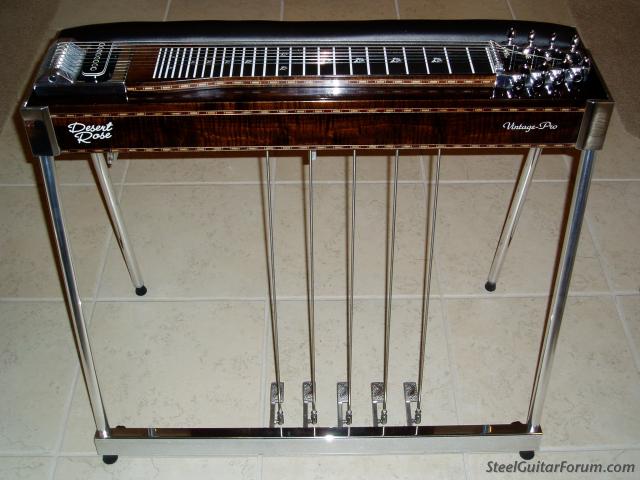
My Desert Rose


I've been playing the Desert Rose S-8 for about a month now, and I've pretty much finalized the D6/G copedent. I love it! I can go from E9th country styles to C6th swing styles just by moving my foot to the right.
   LKL LKV LKR  P1  P2  P3  P4  P5  RKL RKR
F# +G +G
D +D# +E +E -C#
B +C# +C
A +B -G#
F# -F +G
D +D# +E +D#
B +C
G +A -E -F#

P1 and P2 work like E9th A&B transposed down a step from E to D. The vertical LKV is sort of like the E9th C pedal. LKL is like the E9th F lever.

LKR, P3, P4, P5 and RKL are all standard C6th changes transposed up a step from C to D. LKL is like the C to C# lever, and RKR is like the A to Bb lever.

Here's a western swing tune of mine from a Burnside Scramblers rehearsal: Sagebrush Shuffle

September 14, 2009

Mr. Music Birthday Bash

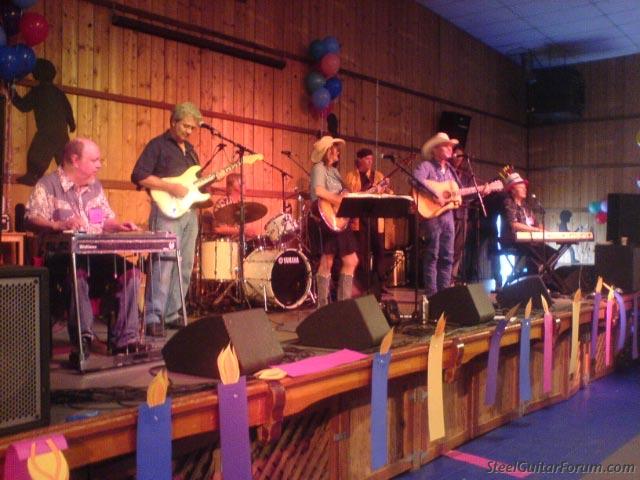
My friend Mr. Music threw a birthday party for himself and everyone else who turns 60 this year. I got to play with 3 different bands: The Country All-Stars, Shannon Rider, and Band'O'Geezers. Here's a picture of the All-Stars, taken by Scott Shewbridge:


Brad Cox captured the birthday cake ceremony on video:


I got to see a lot of old friends. It was a great party!

August 14, 2009

A tweak from experience

I've been fooling with the 8-string copedent on the back neck of my Williams. I discovered that the B to A lower doesn't sound at all like at A to B raise, and the raise is that "country sound". Here's the update:
   LKL LKV LKR  P1  P2  P3  P4  P5  RKL RKR
F# +G +G
D +D# -C# +E +E
B +C +C#
A +B -G#
F# -F +G
D +D# +E +D#
B +C -A
G -E -F#
Chuck's still building the guitar. It's been 4 months since I ordered it.

July 31, 2009

Desert Rose

Chuck Back is building me an 8 string Desert Rose steel guitar. It's taking longer than expected because so many of the parts are custom made as opposed to a ten string and it's 116 degrees in Arizona so he can only work mostly at night but his noisy machinery disturbs his neighbors and also the paint doesn't dry right in this heat.

Chuck's going to Albuquerque this weekend and he'll send me a picture of the cabinet when he gets back.

What it is.

July 23, 2009

8 Strings - A Really Great Idea!

I think this might be a Really Great Idea. 8 strings with the range of a standard guitar, and most of the capabilities of a E9/C6 double-ten.

LKL LKV LKR P1 P2 P3 P4 P5 RKL RKR
F# +G +G
D +D# -C# +E +E
B +C -A +C#
A -G#
F# -F +G
D +D# +E +D#
B +C -A
G -E -F#